
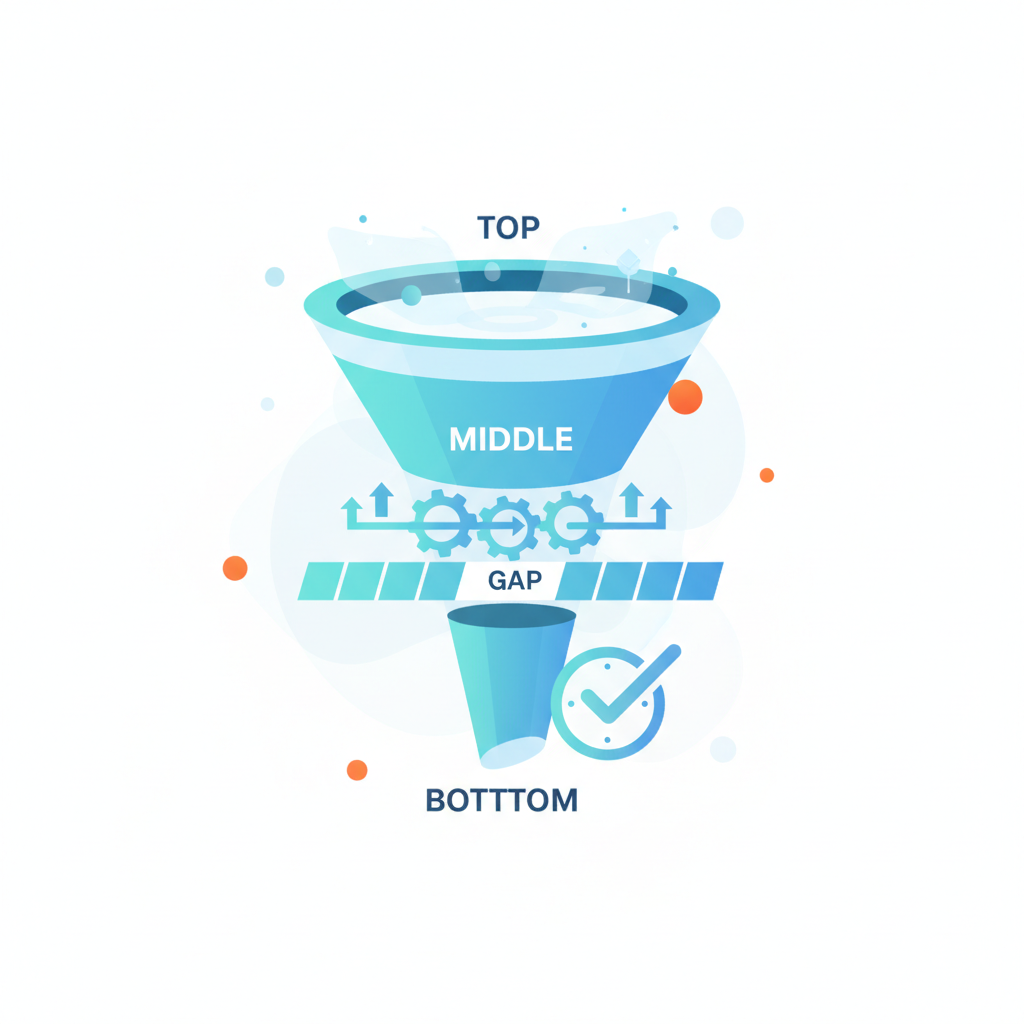
In the world of B2B sales, a disproportionate amount of attention is spent on two areas: filling the top of the funnel (TOFU) with leads and perfecting the final close at the bottom (BOFU). While both are critical, this focus often creates a vast, treacherous territory in between where promising deals go to die: the middle of the funnel (MOFU). This is the consideration stage, the 'messy middle' where prospects are no longer just problem-aware but are actively evaluating solutions. It's here that momentum is lost, sales cycles stretch, and customer acquisition costs balloon.
Optimizing this crucial phase isn't about pushing harder; it's about guiding smarter. It requires a sophisticated blend of data, psychology, and technology to remove friction, build confidence, and create a clear, compelling path to purchase. This guide provides advanced strategies to collapse the gap between consideration and conversion, helping you speed up your sales cycle and close more deals, faster.
The MOFU Bottleneck: Why Deals Stall in the Consideration Phase
The transition from TOFU to MOFU represents a significant psychological shift for the buyer. They move from a phase of discovery and education ('What is my problem?') to one of evaluation and comparison ('What is the best way to solve my problem?'). This is where the sales process becomes congested. Understanding why is the first step to clearing the path.
- Indecision and Analysis Paralysis: Today's buyers are armed with more information than ever before. While this is empowering, it can also lead to paralysis. They get bogged down in feature-by-feature comparisons, endless review-reading, and uncertainty about which solution truly fits their unique context.
- Lack of Stakeholder Alignment: In B2B, you're rarely selling to a single person. The buying committee can include users, managers, IT, finance, and executive leadership, each with different priorities and concerns. A failure to build consensus among these stakeholders is a primary reason deals stall. The champion you've been working with may love your product, but if they can't convince the CFO of its ROI, the deal is dead.
- The Impact of 'The Messy Middle': Coined by Google, 'the messy middle' describes the complex, non-linear journey buyers take between trigger and purchase. They loop between exploration and evaluation, influenced by countless touchpoints. For B2B, this means a prospect might read your blog post, then see a competitor's ad, then ask for a peer recommendation on LinkedIn, then revisit your pricing page—all before ever talking to a sales rep. This chaotic journey extends the sales cycle and makes attribution challenging.
Data-Driven Segmentation: Moving Beyond Basic Lead Scoring
To effectively navigate the messy middle, you need to move beyond simple lead scoring models based on demographics or firmographics. The key is to decode behavior to understand intent. A prospect's actions speak louder than their job title.
Implementing Behavioral Triggers
High-intent MOFU prospects leave a trail of digital breadcrumbs. The goal is to identify and act on these signals. Sophisticated B2B website visitor tracking software is essential here. Instead of just knowing a company visited your site, you can see which specific pages they viewed and for how long. Key behavioral triggers include:
- Multiple visits to the pricing or features page.
- Downloading a technical whitepaper or a detailed case study.
- Using an interactive tool, like an ROI calculator.
- Registering for a product-focused webinar.
- Revisiting the website after a period of dormancy. Platforms like VisitReveal offer a Lead Re-Visit Notification feature, which automatically alerts a sales rep when a prospect in their CRM returns to the site, signaling the perfect moment for a timely follow-up.
Dynamic Content Tracks
Once you identify these behaviors, you can create dynamic content tracks that cater to specific persona pain points. A thorough SaaS Marketing Assessment can help you define these personas and their unique journeys. For example:
- A prospect from a finance background who lingers on the pricing page gets an automated email with a TCO (Total Cost of Ownership) comparison guide.
- A user from the IT department who downloads an integration guide gets a follow-up with a technical deep-dive video.
- A C-level executive who reads a high-level strategy article is nurtured with analyst reports and big-picture value propositions.
High-Velocity Content Assets for the Consideration Stage
Generic eBooks and blog posts are for TOFU. The middle of the funnel demands content that actively helps buyers make a decision. These assets are not just educational; they are functional tools for evaluation.
- Interactive ROI Calculators: Instead of telling a prospect they'll save money, let them prove it to themselves. An interactive calculator, like this Fractional CMO Calculator, allows them to input their own data (e.g., team size, current costs, efficiency metrics) and see a personalized projection of their potential return on investment. This becomes a powerful internal selling tool for your champion.
- 'Bridge Content': Most case studies focus on the glorious end results. Bridge Content, however, focuses on the journey. These are assets—case studies, interviews, or timelines—that detail the implementation process, onboarding experience, and how challenges were overcome. This type of content de-risks the decision by showing prospects exactly how they will get from their current state to the desired outcome.
- Expert-Led Webinars and Live Q&A: Pre-recorded demos have their place, but a live session with a product expert or solutions engineer is invaluable for dissolving technical objections. It provides a forum for an open dialogue where stakeholders can ask a niche, specific questions and get immediate, credible answers. A comprehensive SaaS Growth & Marketing Audit can often uncover the most common and pressing questions your prospects have, helping you theme these sessions effectively.
Personalization at Scale: The Hybrid Human-Digital Approach
As prospects move deeper into the funnel, their need for personalization increases. The challenge is delivering this personalized touch without requiring an army of sales reps. The solution is a hybrid approach that blends intelligent automation with timely human intervention, all orchestrated through a central system.
A unified Sales Enablement Platform is the backbone of this strategy. It connects marketing's content and messaging with sales' outreach efforts, ensuring consistency and relevance. This integration allows for tactics like:
- 'Warm-Outreach' Sequences: Instead of generic cold outreach, use automation that feels bespoke. With tools like VisitReveal's Email Sequences, you can create automated follow-ups that are triggered by a prospect's behavior. For example, if a prospect downloads a case study on a specific use case, they can be entered into a sequence of 2-3 emails that reference that use case and offer further relevant information.
- The Power of 1-to-1 Video: In a world of automated emails, a personal video message from a sales rep can be a powerful pattern interrupt. Reps can record short videos to introduce themselves, answer a specific question, or provide a custom micro-demo. Many modern tools enable this, and some, like VisitReveal's Sales Collateral Generator, allow reps to embed these personal videos into a polished, templated follow-up page in minutes.
- Synced Messaging: The worst experience for a buyer is hearing one message from marketing content and a completely different one from a sales development rep (SDR). A sales enablement tool with a central Sales Content Library ensures all reps are using the latest, approved messaging, presentations, and collateral. This creates a seamless, trustworthy experience for the buyer.
Social Proof and Trust Building: Reframing the Competitive Landscape
In the MOFU, prospects are actively comparing you to your competitors. Your goal is not to disparage the competition but to frame the decision-making criteria in your favor and build overwhelming trust in your solution.
- Third-Party Validation: Your own testimonials are good; unbiased reviews on sites like G2, Capterra, and TrustRadius are better. Actively manage your presence on these platforms and syndicate these reviews on your own website. This provides the social proof buyers need from a source they trust.
- 'Comparison Intelligence' Assets: Instead of a 'Competitor X vs. Us' battle card that feels biased, create an objective guide titled 'How to Choose the Right [Your Software Category] Solution.' In this guide, you define the key criteria for evaluation—criteria that, coincidentally, highlight your strengths. This positions you as a helpful advisor rather than a defensive salesperson.
- The 'Customer Champion' Strategy: Empower your internal champion to sell on your behalf. Don't just give them a proposal; give them a 'Champion Enablement Kit.' This could be a private, personalized web page or a zip file containing a slide deck they can present, key talking points to address stakeholder concerns, and a one-page summary of the business case. Developing such sophisticated assets often benefits from the guidance of an experienced leader, like a Fractional CMO for SaaS, who specializes in building scalable GTM strategies.
Streamlining the Transition: Collaborative Closing Tactics
As the prospect nears a decision, the final hurdle is often process, not product. Legal, procurement, and security reviews can add weeks or months to a sales cycle. Proactive collaboration is key to streamlining this final transition from MOFU to BOFU.
- Implement 'Mutual Action Plans' (MAPs): A MAP is a shared document that outlines every step, deliverable, and stakeholder involved in the evaluation and purchasing process. It includes a timeline with clear ownership for each task (on both your side and the client's). This turns the final stages from a mysterious black box into a collaborative, transparent project plan, creating momentum and accountability.
- Optimize the Hand-off: The transition from marketing-led nurturing to sales-led negotiation must be seamless. This is managed within your B2B Sales CRM, where lead status changes trigger automated alerts and task creation. The sales rep should have full visibility into the prospect's entire history of engagement, from the first ad they clicked to the last webinar they attended.
- Preemptive Documentation Sharing: Don't wait for legal to ask for your security compliance documents or for procurement to request your standard MSA. Make these documents readily available in a secure, trackable format via your sales content library. Sharing these preemptively shows transparency and allows these parallel workstreams to begin early, preventing them from becoming last-minute roadblocks. For more insights on building robust go-to-market motions, a resource like a SaaS marketing book can provide foundational knowledge.
Measuring Success: MOFU Velocity Metrics You Must Track
You can't optimize what you don't measure. To truly understand the health and efficiency of your middle funnel, you need to track specific velocity metrics. These KPIs pinpoint where deals are slowing down and help you quantify the impact of your optimization efforts.
- Stage-to-Stage (S2S) Conversion Rates: Track the percentage of deals that advance from one stage to the next (e.g., from 'Qualified Lead' to 'Demo Scheduled'). A significant drop-off between two specific stages is a clear sign of a 'leak' or bottleneck that needs immediate attention.
- Time in Stage: How long, on average, do deals spend in your 'Consideration' or 'Evaluation' stage? Monitor this metric over time. While a complex deal may naturally take longer, a rising average 'Time in Stage' across the board can indicate new friction in your process. Correlate this with win rates; often, the longer a deal lingers, the less likely it is to close.
- Attribution Modeling: Move beyond last-touch attribution. Use a multi-touch or U-shaped attribution model to assign revenue credit to the MOFU assets that influenced the deal. Did the webinar they attended or the ROI calculator they used contribute to the win? Knowing this proves the value of your content and informs future strategy. Many modern platforms offer built-in Sales Reports that help visualize this data and track progress against goals.
Ultimately, collapsing the gap in the middle of the funnel is about transforming the buyer's journey from a series of hurdles into a guided pathway. By leveraging behavioral data, creating high-impact content, personalizing outreach at scale, and fostering collaborative closing, you can build unstoppable momentum. You stop being a vendor who is selling and become a trusted partner who is helping them buy—and that makes all the difference in accelerating the journey from interest to signed contract.