
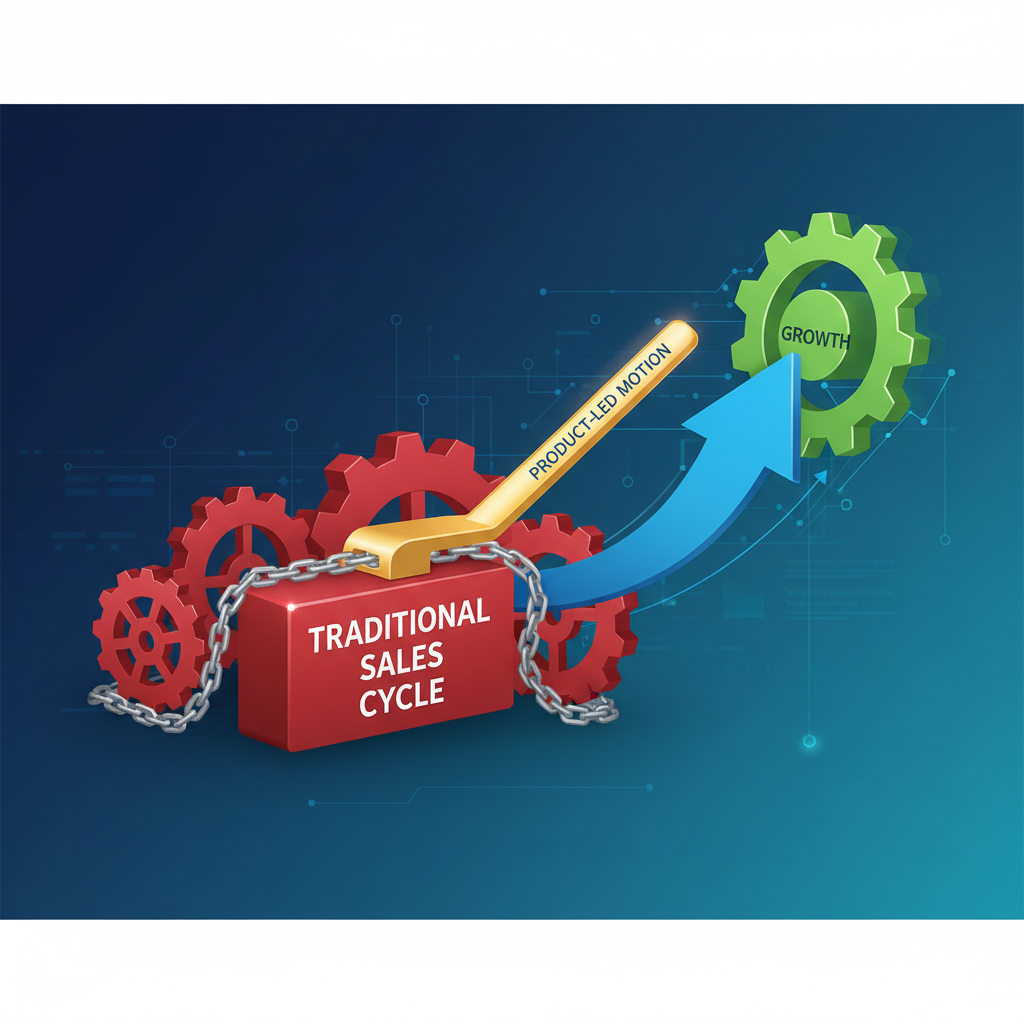
The Friction Problem: Why Traditional Sales Processes are Failing Modern Buyers
The landscape of B2B buying has fundamentally shifted. Today’s buyers are researchers, investigators, and self-educators. They arrive on your website armed with more information than ever before, having already consulted with their peers, read reviews, and analyzed competitors. Their preference has moved decisively away from sales-led discovery and towards self-service exploration. They want to experience value first-hand, not be told about it in a 30-minute pitch. Yet, many organizations remain tethered to high-friction, legacy sales models that create more barriers than bridges.
These traditional processes are riddled with frustrating touchpoints that actively repel the modern buyer:
- Gatekeeping Pricing: Hiding pricing behind a 'Contact Us' form forces a prospect into a sales conversation they aren't ready for. This lack of transparency breeds mistrust and immediately introduces friction.
- Mandatory Demos: Requiring a scheduled demo to see the product creates a bottleneck. Buyers want to explore on their own time, not conform to a salesperson's calendar. This is often a thinly veiled qualification call that serves the seller, not the buyer.
- Long SDR Qualification Loops: The process of filling out a form, waiting for an SDR to call, scheduling a discovery call, and then finally getting to an Account Executive can take days, if not weeks. In that time, the buyer's initial excitement and intent have evaporated.
This chasm between a user's first interaction and their first experience of value is the 'Time-to-Value' gap. The longer this gap, the higher your funnel churn. Every form, every required call, every waiting period is an opportunity for a potential customer to lose interest and move to a competitor who offers a more direct path to their solution. In an era of instant gratification, a high-friction sales cycle is a competitive disadvantage.
Defining the Product-Led Motion (PLG) as a Competitive Moat
Product-Led Growth (PLG) is not just a buzzword; it's a go-to-market strategy that places the product itself at the center of the customer journey. It serves as the primary driver for user acquisition, conversion, expansion, and retention. In a PLG model, the product does the selling.
It’s crucial to differentiate PLG from simply having a freemium plan. Freemium is a pricing tactic—a free, feature-limited tier. PLG is a comprehensive strategy where the entire organization—from engineering and product to marketing and sales—is oriented around the user's product experience. The goal is to deliver tangible value upfront, trusting that a positive experience will naturally lead to commercial conversion.
This is the power of 'Show, Don't Tell'. A traditional sales process relies on telling the prospect about the product's value through slide decks, case studies, and talk tracks. While these have their place, they are abstract representations of value. A product-led motion, by contrast, shows the value by allowing the user to experience it directly. When a user solves a small problem or achieves a quick win within the first few minutes of using your product, the value becomes real and personal. This hands-on validation is infinitely more powerful than any sales pitch. Tools like a dynamic Sales Collateral Generator, which allows reps to create personalized micro-sites for prospects post-call, are a step in this direction—moving from static 'telling' to interactive 'showing'.
Strategic Entry Points: Freemium, Free Trials, and Reverse Trials
Adopting a product-led motion begins with choosing the right entry point for your users. The three most common models are Freemium, Free Trials, and the increasingly popular Reverse Trial. The right choice depends heavily on your product's complexity, your target market, and the time it takes for a user to reach their 'Aha! Moment'.
- Freemium: Best for products with a broad appeal and a fast time-to-value. The goal is mass adoption, allowing users to stay on a free plan indefinitely while offering compelling reasons to upgrade for more advanced features, higher usage limits, or collaboration capabilities.
- Free Trial: Ideal for more complex products where the full suite of features is needed to demonstrate value. It offers a time-limited (e.g., 14 or 30 days) window for users to experience the premium version, creating a sense of urgency to evaluate and purchase.
- Reverse Trial: This hybrid model is a powerful strategy that starts users on a full-featured free trial. At the end of the trial period, if they choose not to purchase, their account is automatically downgraded to a feature-limited freemium plan instead of being deactivated. This combines the urgency of a trial with the long-term retention and latent conversion potential of a freemium model.
Regardless of the model, the single most critical factor is engineering a fast 'Time-to-Value.' Your onboarding process must be ruthlessly optimized to guide a new user to their 'Aha! Moment'—the point where they personally experience the core value of your product—within the first session. This is not about showing them every feature; it's about leading them to a specific, meaningful outcome as quickly and seamlessly as possible.
The Evolution of Sales: From Gatekeeper to Product-Led Sales (PLS)
In a PLG world, the sales team doesn't disappear; it evolves. The traditional salesperson, a gatekeeper of information and access, is replaced by a Product-Led Sales (PLS) professional, who acts as a consultant and strategist. Their goal shifts from 'closing deals' to 'accelerating usage and expansion'. They leverage product data to identify opportunities and help users derive more value, which in turn leads to revenue.
This evolution requires a new way of qualifying leads. Marketing Qualified Leads (MQLs), based on proxy signals like whitepaper downloads or webinar attendance, become less relevant. The new gold standard is the Product Qualified Lead (PQL). A PQL is a user or account that has achieved predefined value milestones through product usage. They've demonstrated buying intent not by filling out a form, but by actively using the product in a way that signals a strong fit and a readiness to convert or expand.
The role of the sales team, now often called 'Sales-Assist' or 'Product Specialists,' is to engage with these PQLs at the perfect moment. Intervention is no longer about cold outreach but about data-driven assistance. For example, a feature like a Lead Re-Visit Notification can alert a sales-assist rep when a high-potential user from a target account returns to the pricing page after a period of inactivity. This is a clear PQL signal that warrants a timely, contextual, and helpful touchpoint, guiding them toward the next step in their journey.
Infrastructure for Intent: Leveraging Product Usage Data
A successful PLG strategy runs on data. Product usage data is the fuel for identifying PQLs, personalizing user communication, and informing sales-assist outreach. The first step is to meticulously map the user journey to identify the key behavioral signals that predict conversion and expansion. These aren't just vanity metrics like logins; they are specific actions that correlate with long-term customer success.
To capture and act on this data, you need a modern tech stack that connects user behavior to your GTM teams. This typically includes:
- Product Analytics Tools: To track in-app events and user flows.
- Customer Data Platform (CDP): To unify user data from multiple sources.
- Integrated CRM: To give sales a complete view of a user's product engagement alongside their firmographic and demographic data.
A comprehensive Sales Enablement Platform that integrates these functions can be incredibly powerful, breaking down the silos between product data and sales activity. Combining in-product behavioral data with other intent signals, such as data from a B2B website visitor tracking software, creates a holistic view of an account's interest level, both inside and outside the product.
With this infrastructure in place, you can automate context-aware communication. For instance, when a user invites three teammates, they might automatically receive an email (perhaps via automated Email Sequences) that highlights advanced collaboration features. When an account hits a usage limit, a sales-assist rep can be notified to proactively discuss an upgrade. This data-driven approach ensures every interaction is relevant and timely.
Bypassing the Procurement Bottleneck: Land and Expand
One of the most significant advantages of a product-led motion is its ability to circumvent the traditional, top-down procurement process. Instead of trying to convince a C-level executive to sign a massive contract for a product their team has never used, PLG employs a bottom-up 'Land and Expand' strategy.
The motion starts by winning over individual users or single teams who adopt the product to solve their specific pain points. They become internal champions. As they experience value and share their success, usage naturally spreads organically throughout the organization. This user-led adoption effectively forces organizational awareness and creates a groundswell of demand.
When the time comes to discuss a formal, company-wide contract, the conversation is entirely different. The sales team is no longer selling a promise; they are discussing the formalization of value that is already being realized. They can negotiate from a position of immense strength by presenting product usage metrics that prove the tool's ROI. The discussion shifts from 'Why should we buy this?' to 'How can we best roll this out to everyone to maximize the value we're already seeing?' This dramatically shortens sales cycles and increases win rates for large enterprise deals.
Measuring Success: New KPIs for the Product-Led Era
Transitioning to a product-led model requires a corresponding shift in how you measure success. Traditional sales metrics like the number of demos booked or MQL-to-SQL conversion rates lose their prominence, replaced by KPIs that reflect organic growth and product value.
Key metrics for the product-led era include:
- Time to Value (TTV): How quickly does a new user reach their 'Aha! Moment'? This is a leading indicator of activation and retention.
- Product Qualified Leads (PQLs): The number of users or accounts hitting key activation milestones that signal purchase intent.
- Activation Rate: The percentage of signups that reach the 'Aha! Moment' and become active users.
- Natural Rate of Growth (NRG): As defined by a VC firm, Battery Ventures, this measures the portion of your growth that comes from organic, non-paid channels driven by your product and brand. It’s a powerful indicator of sustainable growth.
The ultimate goals are to reduce Customer Acquisition Cost (CAC) and shorten the sales cycle length. A PLG motion achieves this by automating the top of the funnel and allowing sales to focus only on high-intent, product-qualified opportunities. Conducting a SaaS Growth & Marketing Audit can provide a clear baseline of your current metrics, allowing you to accurately measure the impact of your shift. Furthermore, as you optimize your GTM engine and reduce sales overhead, you can model the financial impact; using a Fractional CMO Calculator can even help visualize the cost savings of leaner, more strategic leadership compared to traditional executive hires.
Future-Proofing Your GTM: Transitioning from Sales-Led to Product-Led
Shifting from a deeply entrenched sales-led culture to a product-led one is a significant undertaking that extends beyond the marketing and sales departments. It requires a unified vision and tight alignment across Product, Engineering, Marketing, and Sales. The entire company must commit to putting the user experience first. This kind of major strategic pivot often requires strong, experienced leadership, which is why many companies turn to a Fractional CMO for SaaS to guide the transition and overcome internal resistance.
However, it's important to recognize that a pure PLG motion isn't a silver bullet for every company. Common pitfalls arise when a product is too complex, requires extensive implementation, or serves a market that is not accustomed to self-service (e.g., highly regulated industries). Forcing a product-led model in these scenarios can lead to user frustration and high churn.
For many B2B SaaS companies, the optimal solution is a Hybrid Model. This approach blends a product-led motion for the initial stages of acquisition and activation with a high-touch, sales-assisted process for enterprise expansion, complex use cases, and strategic accounts. A thoughtful SaaS Marketing Assessment can help determine where your company falls on the spectrum and design the right balance. This allows you to enjoy the efficiency and scale of PLG while still providing the necessary guidance and strategic partnership that large customers require. By embracing this balance, you can build a resilient, efficient, and customer-centric growth engine for the future. For those looking to delve deeper into these strategies, a good SaaS Marketing Book can provide invaluable frameworks and case studies.